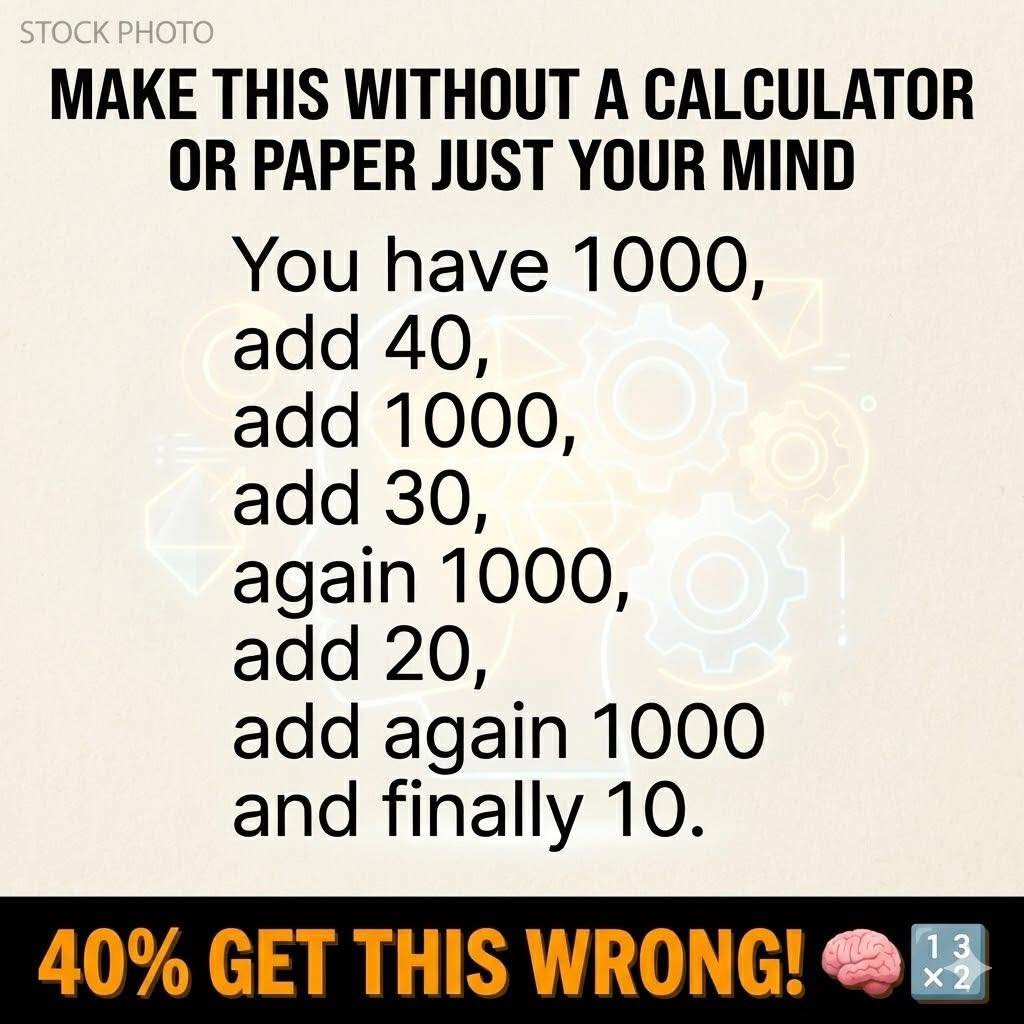
Social media is currently obsessed with a basic addition problem that seems fit for a primary school student, yet it carries a failure rate that is surprisingly high. The challenge asks participants to add a sequence of numbers mentally, without the aid of a calculator or even pen and paper.
The Psychology of the Mistake
Why do so many people arrive at 5000 when the actual answer is 4100? The answer lies in cognitive decimal processing. As you add 1000s and smaller tens (40, 30, 20), your brain builds a pattern. When you reach 4090 and are asked to add the final 10, the brain’s “auto-complete” function often jumps to the next major thousand (5000) instead of staying within the correct decimal place (4100).
A Lesson in Focus
This brain teaser is frequently used by educators to demonstrate the importance of slow, deliberate thinking versus fast, intuitive reactions. In psychology, this is known as moving from “System 1” (fast, emotional) to “System 2” (slow, logical) thinking.
How to Solve It Correctly
The most efficient way to avoid the trap is to group the thousands first ($1000 \times 4 = 4000$) and then the tens ($40 + 30 + 20 + 10 = 100$). The final result: 4100.
Did the trap catch you? Let us know your first answer in the comments! 🧠✨