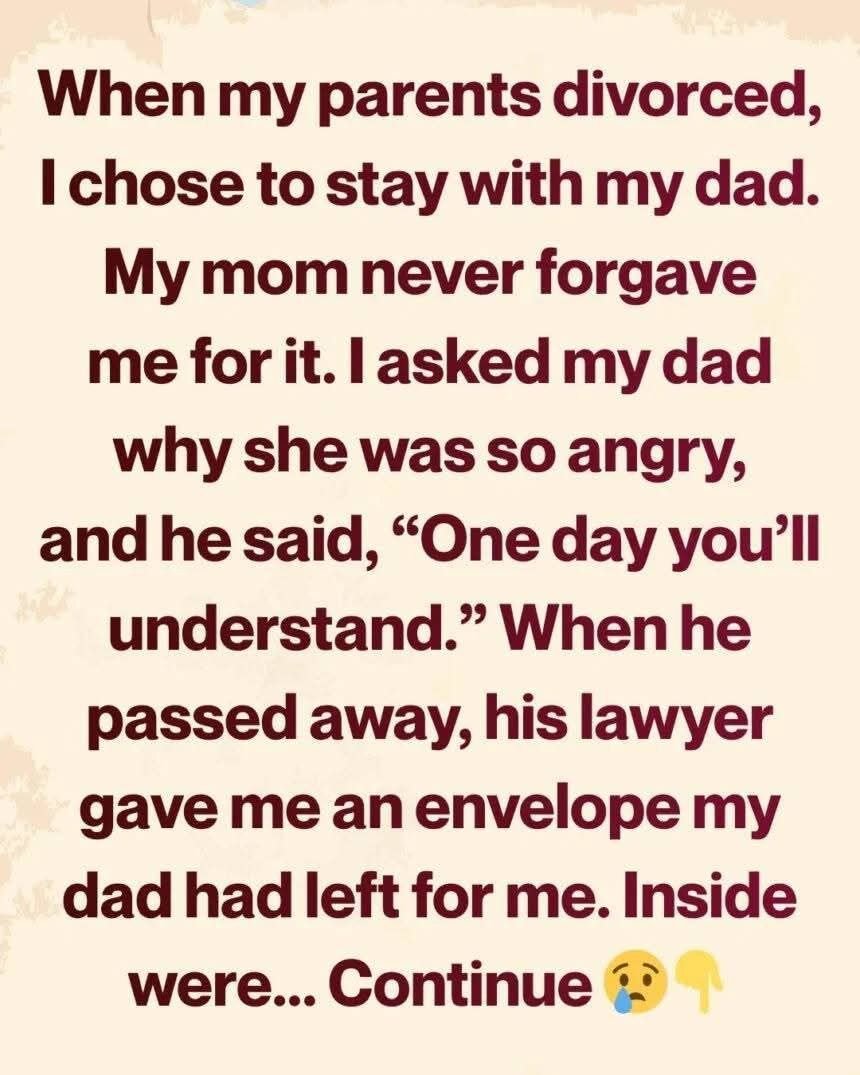
When my parents divorced, it didn’t feel like a separation—it felt like the ground beneath me had been split in two. One house became two. One life became choices I was too young to make. Everyone kept asking the same question, gently but persistently: *“Who do you want to live with?”*
As if love could be measured. As if choosing one parent didn’t mean breaking the other.
In the end, I stayed with my dad.
He made it easy to believe I’d made the right choice. He learned how to cook my favorite meals—even the ones he used to joke were “too complicated.” He showed up to every school event, sometimes early, always proud. On quiet nights, he’d sit with me, not saying much, just making sure I never felt alone. With him, life felt steady. Safe.
But my mom… my mom felt like a door that had quietly closed.
She stopped coming around as much. Birthdays passed without her voice. Holidays felt incomplete, like a chair at the table no one dared mention. When she did call, her tone was distant, careful—like she was speaking through glass. Every interaction left me wondering what I had done wrong.
“Why is she so angry with me?” I’d ask my dad, over and over again. “Did I hurt her?”
He would always respond the same way. A soft smile. A gentle hand on my shoulder.
One day you’ll understand.”
But I didn’t.
Not at twelve, when I still waited by the phone.
Not at eighteen, when I stopped expecting it to ring.
And not even years later, when life had already carried me forward whether I was ready or not.
I certainly didn’t understand the day I stood at my father’s funeral.
The world felt unbearably quiet. I held the folded program in my hands, reading the same lines again and again, not because I needed to—but because I didn’t know what else to do. People came and went, offering condolences that blurred into one another. All I could think was how much I still needed him.
How many questions I had never stopped asking.
How I would never hear his answer again.
—
A week later, I sat in a lawyer’s office, the air heavy with that strange stillness that follows loss.
He didn’t say much. Just reached into his desk and slid a plain white envelope toward me.
“This is from your father,” he said quietly.
My name was written across the front in his familiar handwriting—steady, careful, unmistakably his. For a moment, I just stared at it, afraid that opening it would make everything final in a way I wasn’t ready for.
But I opened it anyway.
Inside, there were no long letters. No final speech. No grand explanation.
Just paper after paper—receipts.
Rent payments. Utility bills. Medical expenses.
All of them addressed to my mother.
They stretched back years.
At first, it made no sense. My mind tried to piece it together, but nothing fit. Why would he keep these? Why would he pay for things that weren’t his responsibility anymore?
Then, tucked between the pages, I found a small note. Just a few lines, written in the same calm handwriting I had known my whole life.
*“She wasn’t angry because you stayed with me. She was ashamed you’d see her struggling. I helped her stay afloat so you’d always have two safe homes.”*
Something inside me shifted in that moment—quietly, but completely.
All those years, I had built a story in my head. A story where my mother blamed me. Where her distance was rejection. Where her silence meant resentment.
But the truth was something else entirely.
She hadn’t pulled away because she didn’t love me.
She had pulled away because she did.
Because she didn’t want me to see the weight she was carrying. Because she couldn’t bear the idea of me looking at her and seeing struggle instead of strength.
And my dad…