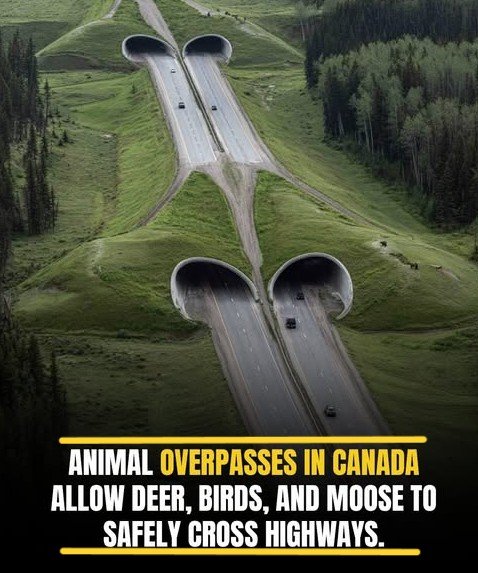
Across the globe, highways are lifelines for people—but death traps for wildlife. Every year, collisions with speeding vehicles claim the lives of countless deer, moose, bears, and smaller creatures. These crashes devastate families, damage ecosystems, and leave communities searching for answers. Canada, however, has come up with an ingenious solution: build bridges for animals.
These aren’t gray slabs of concrete. They are lush, living structures draped in trees, wild grasses, and shrubs, designed to look and feel like part of the forest itself. From the sky, they appear as natural extensions of the wilderness; from the ground, they allow streams to flow and foxes to scurry without interruption. On these bridges, deer stroll, moose lumber, and even black bears make their crossings—safe from the deadly rush of traffic below.
The impact has been extraordinary. In regions where these eco-bridges exist, wildlife-vehicle collisions have plummeted. Migration paths are being restored, animals are reconnecting with their traditional ranges, and researchers are witnessing natural behaviors once thought lost to urban sprawl. The message is undeniable: roads don’t have to divide nature—they can help reconnect it.
Canada’s innovation is sparking a global trend. In the Netherlands, “ecoducts” stretch across highways, linking fragmented habitats. In the United States, states like Colorado and Utah are constructing overpasses and tunnels to give elk, cougars, and bears a fighting chance. Slowly but surely, the idea is spreading: modern infrastructure can evolve to protect life, not just serve it.
But Canada’s bridges raise a deeper question: why stop with highways?
-
Wildlife-friendly cities: Imagine neighborhoods laced with green corridors, rooftop gardens, and flowering trees that sustain pollinators, songbirds, and squirrels.
-
Suburban coexistence: Picture cul-de-sacs designed with rain gardens, native plants, and mini-wetlands where animals find safe refuge instead of danger.
-
Eco-conscious industry and farming: Envision farmlands edged with hedgerows, water ponds, and buffer zones that welcome wildlife rather than drive it away.
-
Sustainable utilities: Even dams, canals, and power lines could be reimagined to allow safe passage for fish, birds, and mammals.
The lesson is powerful: harmony between people and nature doesn’t happen by accident—it can be engineered. Canada has proven that with courage and creativity, it’s possible to transform barriers into bridges.
Progress does not have to come at nature’s expense. With thoughtful design and bold imagination, humans and wildlife can thrive together, side by side, sharing a future where roads no longer separate us—but bring us closer.